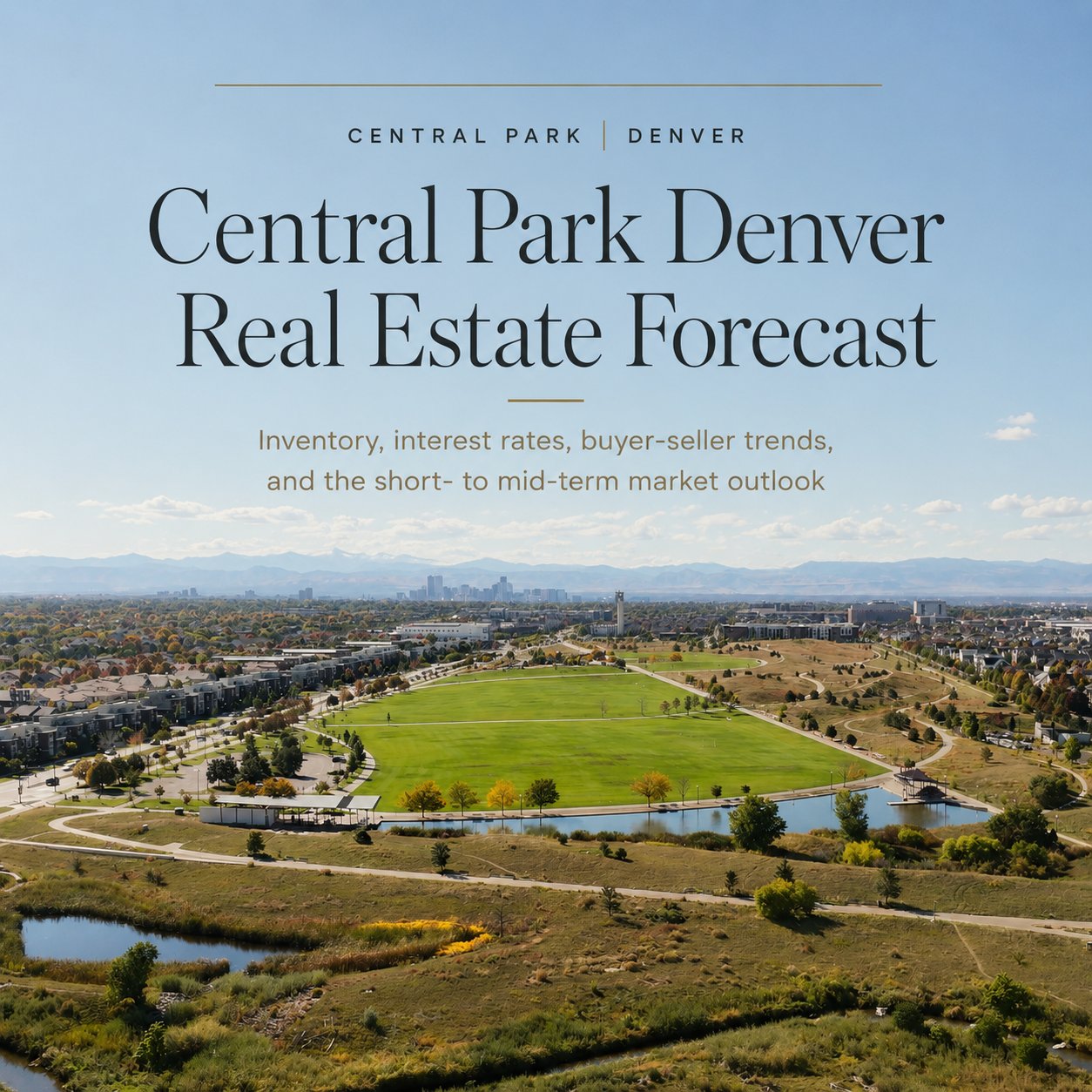
Central Park Denver Market Forecast
Target keyword: Central Park Denver real estate forecast
The Central Park Denver real estate forecast points to a more balanced, selective market rather than the extreme seller’s market conditions seen during the peak years. For buyers and sellers, the next phase of the market will likely be shaped by three major factors: inventory, interest rates, and pricing discipline.
Denver’s broader market has shown signs of renewed activity as new inventory enters the market, with DMAR noting that buyer demand surged in March as new listings increased heading into spring. At the same time, mortgage rates remain a key constraint, with the average 30 year fixed rate recently reported above 6.5 percent.
For Central Park specifically, that means demand should remain present, but buyers are likely to stay selective.
Short Term Outlook
In the short term, Central Park is likely to remain a balanced to slightly segment-driven market.
Well-priced homes in strong locations should continue to attract attention, especially if they are updated, well presented, and positioned near parks, trails, retail, or desirable sub-areas. Homes that are overpriced or need significant work may continue to sit longer and require price adjustments.
Short-term expectations include:
- More buyer activity during spring and early summer
- Continued sensitivity to mortgage rate changes
- Stronger performance for turnkey homes
- Longer days on market for homes that miss the pricing window
- More negotiation on listings with extended market time
The key short-term trend is not simply whether the market is “good” or “bad.” It is that buyers are more analytical than they were during the faster-moving market years.
Midterm Outlook
Over the mid-term, Central Park should continue to benefit from strong neighborhood fundamentals: established amenities, parks, trails, newer housing stock, multiple housing types, and long-term buyer recognition.
However, price growth is likely to be more measured than explosive.
Midterm expectations include:
- Modest appreciation rather than rapid price jumps
- Continued demand for well-located homes
- Greater separation between updated and dated properties
- Ongoing importance of HOA costs, taxes, and monthly affordability
- More balanced buyer and seller leverage
Central Park remains a desirable Denver neighborhood, but the market is no longer forgiving of aggressive pricing. Sellers will need to justify value with condition, location, presentation, and recent comparable sales.
Inventory Expectations
Inventory is one of the most important variables in the Central Park Denver real estate forecast.
Denver’s broader market entered 2026 with higher inventory and slower sales compared with the ultra tight years, according to reporting on DMAR market data. That trend gives buyers more choice, but it does not mean every segment of Central Park has abundant supply.
Inventory is likely to vary by property type
Condos and townhomes may offer more options for entry level buyers, especially when HOA dues affect affordability.
Mid range single family homes may remain competitive when priced correctly because they appeal to a broad buyer pool.
Luxury homes may take longer to sell, especially when buyers compare Central Park against other premium Denver neighborhoods.
Newer or highly upgraded homes should continue to outperform homes that need work.
The forecast is not simply “more inventory.” It is more selective absorption. Buyers will have choices, but the best homes should still move faster than the broader market.
Interest Rate Sensitivity
Interest rates will likely be the biggest outside factor influencing Central Park’s market over the next 6 to 18 months.
When rates move lower:
- Buyer confidence may improve
- Monthly affordability improves
- More buyers may re enter the market
- Competition can increase quickly for desirable homes
When rates remain elevated or move higher:
- Buyers become more payment sensitive
- Sellers may need to price more carefully
- Days on market can increase
- Concessions may become more common
Central Park is especially rate sensitive because many homes trade at price points where even small rate changes can meaningfully impact monthly payments.
Buyer Leverage Forecast
Buyer leverage should remain strongest when:
- Homes have been on the market longer than average
- Sellers have already reduced price
- The home needs cosmetic or functional updates
- HOA dues or taxes make the monthly payment less attractive
- Similar competing homes are available
Buyers should not assume they can negotiate heavily on every property. The strongest listings may still see quick activity. But compared with the peak market years, buyers are generally in a better position to evaluate options, request repairs or credits, and avoid rushed decisions.
Seller Leverage Forecast
Sellers should still have leverage when the home has:
- Accurate pricing from day one
- Strong presentation and staging
- Updated finishes
- A desirable floorplan
- A strong micro location
- Limited direct competition
The biggest risk for sellers is overpricing based on older peak market assumptions. In today’s market, the first two to three weeks are especially important. If showings are light or feedback is consistent, sellers may need to adjust quickly.
What This Forecast Means for Buyers
Buyers should focus less on timing the market perfectly and more on identifying value within the current environment.
Smart buyer strategies include:
- Watching days on market closely
- Comparing price reductions
- Evaluating total monthly cost, including HOA dues and taxes
- Looking for homes with strong long term resale characteristics
- Staying ready to act when a well priced home appears
The current forecast favors prepared buyers who know the neighborhood and understand tradeoffs between price, condition, location, and monthly cost.
What This Forecast Means for Sellers
Sellers should approach the market with a strategic pricing and preparation plan.
Important seller strategies include:
- Price based on recent comparable sales, not peak market memories
- Prepare the home carefully before launch
- Watch competing inventory closely
- Understand how interest rates affect buyer affordability
- Be willing to adjust if early market feedback is weak
The best results will likely go to sellers who combine strong presentation with realistic pricing.
FAQs: Central Park Denver Real Estate Forecast
1. What is the short term forecast for Central Park Denver real estate?
The short term forecast is for a balanced, selective market. Buyer demand is still present, but buyers are more cautious and payment sensitive than they were during the peak years. Well priced homes in strong condition should continue to perform well, while overpriced homes may take longer to sell.
2. Will home prices go up in Central Park Denver?
Price growth is likely to be more moderate than rapid. Central Park has strong long term fundamentals, but affordability pressures and higher mortgage rates may limit aggressive appreciation. The strongest price performance will likely come from homes with excellent location, condition, and presentation.
3. Will inventory increase in Central Park Denver?
Inventory may remain higher than the ultra low levels seen in prior years, but it will vary by price point and property type. Condos, townhomes, luxury homes, and dated properties may offer more choice, while well priced single family homes may still move quickly.
4. How do interest rates affect the Central Park market?
Interest rates directly impact monthly affordability. When rates rise, buyers often become more selective and negotiation increases. When rates fall, demand can return quickly, especially in desirable neighborhoods like Central Park.
5. Is Central Park Denver becoming a buyer’s market?
Not across the board. Some listings offer buyer leverage, especially if they are overpriced or have been on the market for a while. However, desirable homes that are priced correctly can still favor sellers. The market is best described as segment specific.
6. Should sellers wait for a better market?
Waiting may help if rates improve or inventory tightens, but it also creates uncertainty. Sellers who need or want to move can still succeed by pricing accurately, preparing the home well, and responding quickly to market feedback.
7. Is now a good time to buy in Central Park Denver?
It can be, especially for buyers with a long term ownership horizon. More inventory and less urgency can create better decision making conditions. Buyers should focus on total cost, property quality, and long term resale value rather than trying to perfectly predict the bottom of the market.
8. What types of homes are likely to perform best?
Homes that are updated, well located, and priced realistically are likely to perform best. Properties near parks, trails, retail, or desirable sub areas may continue to attract strong interest, especially when there is limited direct competition.
Final Thoughts
The Central Park Denver real estate forecast suggests a market defined by selectivity, affordability, and strategy. Central Park remains one of Denver’s most established master planned neighborhoods, but buyers and sellers must now operate with more precision.
For buyers, the opportunity is in having more choice and better negotiating conditions than in the peak market years. For sellers, the opportunity is in standing out through preparation, pricing, and presentation.
By Alex Neir, Denver Real Estate Broker
Specializing in Central Park & luxury residential sales