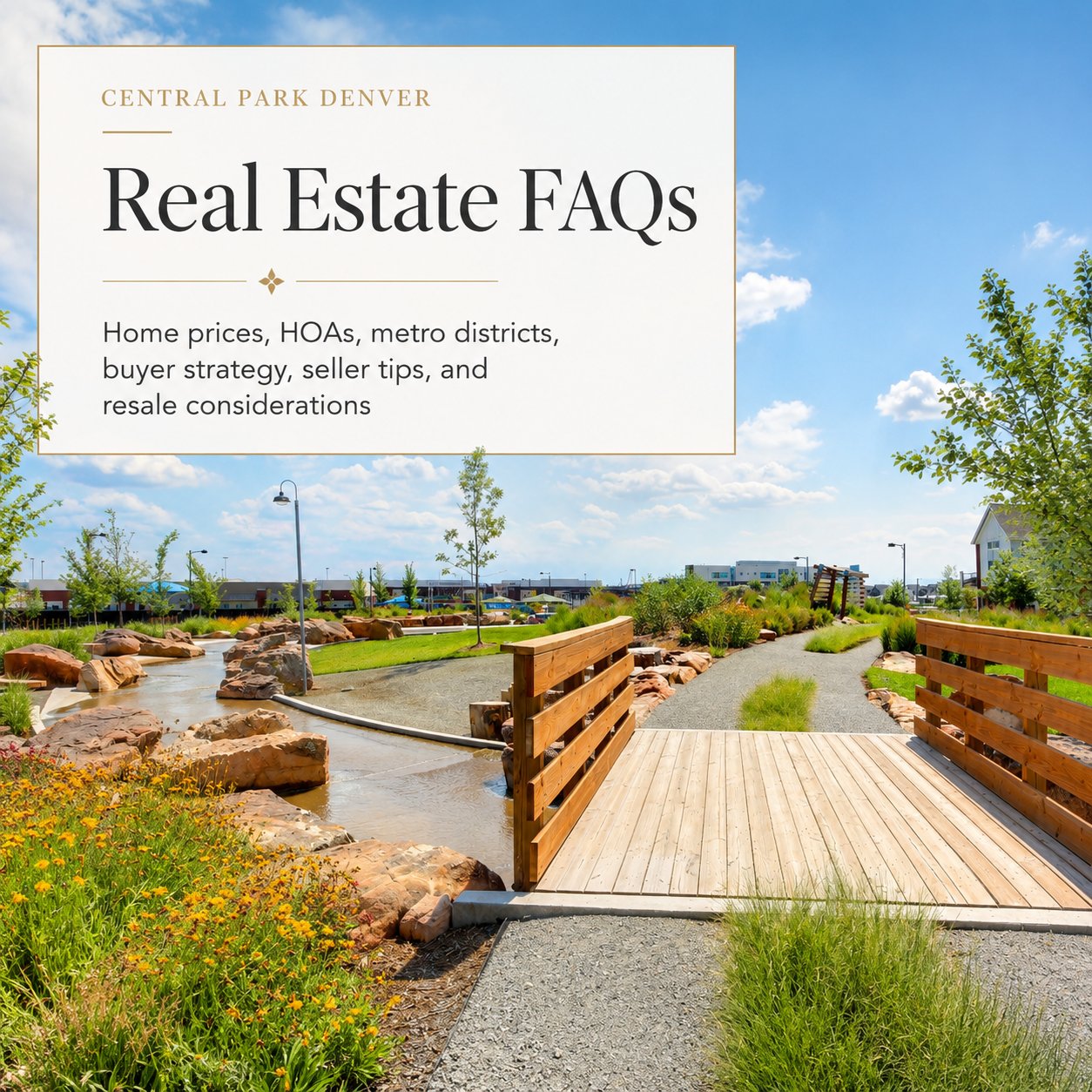
Central Park Denver Real Estate FAQs
Target keyword: Central Park Denver real estate FAQs
Central Park Denver is one of the most actively searched neighborhoods in the Denver real estate market, and it comes with a unique set of buyer and seller questions. Because the neighborhood includes condos, townhomes, paired homes, single-family homes, luxury properties, HOAs, metro districts, parks, trails, schools, and multiple sub-areas, it is rarely useful to evaluate it with broad Denver assumptions.
Below are high-quality Central Park Denver real estate FAQs written from practical broker experience, with clear and neutral answers for both buyers and sellers.
1. Is Central Park Denver a good place to buy a home?
Central Park can be a strong option for buyers who value newer housing, parks, trails, open space, and a master-planned neighborhood layout. The area offers a wide range of housing types, from condos and townhomes to larger single-family and luxury homes.
That said, the right decision depends on your budget, lifestyle, commute, HOA comfort level, and long-term plans. Central Park is not the lowest-cost neighborhood in Denver, so buyers should evaluate total monthly cost, not just purchase price.
2. What types of homes are available in Central Park Denver?
Central Park offers one of the broader housing mixes in Denver. Buyers can find condos, townhomes, paired homes, smaller single-family homes, larger detached homes, new or newer construction, and luxury homes.
This variety is one reason the neighborhood appeals to different buyer groups. However, each housing type comes with different maintenance responsibilities, HOA structures, financing considerations, and resale patterns.
3. Are homes in Central Park Denver expensive?
Compared with many Denver neighborhoods, Central Park often trends toward the higher end because of its newer housing stock, planned amenities, parks, and location. However, pricing varies significantly by property type and sub-area.
Condos and townhomes usually provide lower entry points, while larger detached homes, premium lots, and luxury properties can command substantially higher prices. Buyers should compare homes by total monthly cost, including taxes, insurance, HOA dues, and potential metro district obligations.
4. How competitive is the Central Park Denver real estate market?
Competition varies by price point, property type, condition, and location. Well-priced homes in strong condition may still attract quick interest, especially when inventory is limited. Homes that are overpriced, dated, or have higher ownership costs may sit longer and create more room for negotiation.
Central Park is best understood as a segment-specific market. Some homes feel competitive, while others require patience and pricing adjustments.
5. Do homes in Central Park Denver have HOA fees?
Many homes in Central Park have HOA fees, especially condos, townhomes, paired homes, and some detached properties. The amount and coverage vary widely.
HOA dues may cover exterior maintenance, landscaping, snow removal, shared insurance, amenities, trash, or common area upkeep. Buyers should always review HOA documents carefully to understand what is covered, what is not covered, and whether there are rental restrictions, reserve concerns, or planned fee increases.
6. What are metro districts, and do they matter in Central Park?
Metro districts are special taxing districts often used to fund infrastructure such as roads, utilities, parks, and community improvements. Some areas of Central Park may have additional tax obligations tied to metro districts.
For buyers, this matters because two homes with similar purchase prices can have different monthly costs depending on property taxes and district obligations. Metro district costs should be evaluated alongside mortgage payment, HOA dues, insurance, and maintenance.
7. Is Central Park Denver good for first-time buyers?
Central Park can work well for first-time buyers, especially those considering condos, townhomes, or paired homes. These options may provide a more accessible entry point than larger detached homes.
First-time buyers should be especially aware of HOA dues, condo financing requirements, property taxes, insurance, and future resale flexibility. A lower purchase price does not always mean a lower monthly payment if HOA fees are high.
8. Is Central Park Denver good for move-up buyers?
Yes, Central Park can be a strong fit for move-up buyers who want more space, newer construction, access to parks and trails, and a neighborhood with multiple housing options. Move-up buyers often look at larger single-family homes, premium lots, finished basements, and homes near parks or town centers.
The main consideration is value discipline. Larger homes can vary widely in price depending on builder, lot position, upgrades, and sub-area, so recent comparable sales matter.
9. What should sellers know before listing a home in Central Park?
Sellers should understand that preparation and pricing are critical. Buyers in Central Park often compare similar homes across multiple sub-areas, builders, and housing types. Homes that are clean, staged, well photographed, and priced correctly usually perform better than homes that rely only on neighborhood demand.
Sellers should also review HOA compliance, property condition, recent comparable sales, and competing inventory before going live. The first few weeks on market are especially important.
10. Do Central Park homes sell quickly?
Some do, but not all. Days on market depends on price, condition, location, property type, and overall buyer demand. Well-positioned homes can sell quickly, while homes with pricing issues or condition concerns may require more time.
In a more balanced market, sellers should not assume that simply listing in Central Park guarantees a fast sale. Buyers are more analytical and often compare value carefully before writing an offer.
11. How important is micro-location in Central Park Denver?
Micro-location is very important. A home near a park, trail, town center, open space, or quiet interior street may perform differently than a similar home in a less desirable position.
Central Park is large, and its sub-areas can feel different from one another. Buyers should consider walkability, traffic patterns, park access, lot orientation, proximity to retail, and long-term resale appeal.
12. Are condos and townhomes good options in Central Park?
Condos and townhomes can be good options, especially for buyers seeking lower maintenance or a more accessible price point. Condos often offer simplicity and lower purchase prices, while townhomes may provide more space, private entries, garages, and stronger resale flexibility.
The key is to review HOA dues, financing requirements, maintenance responsibilities, rental restrictions, and long-term affordability. The best option depends on the buyer’s budget and lifestyle goals.
13. Is Central Park Denver a good investment?
Central Park is generally more of a long-term stability and appreciation market than a high-cash-flow rental market. Its appeal comes from location, amenities, housing variety, and consistent buyer demand.
Investors should carefully evaluate purchase price, HOA dues, rental restrictions, property taxes, and likely rent. Some properties may work well as long-term holds, but not every Central Park home will produce strong monthly cash flow.
14. How do schools affect real estate in Central Park Denver?
Schools can influence buyer interest, but Denver’s school choice system makes the relationship more nuanced than in traditional neighborhood school assignment areas. Buyers should not assume that living near a school guarantees enrollment.
From a resale standpoint, school perception may affect demand, but it is only one factor. Property type, condition, price, location, HOA costs, and overall market conditions also play major roles.
15. What is the biggest mistake buyers and sellers make in Central Park?
For buyers, the biggest mistake is focusing only on the home’s price without fully evaluating HOA dues, taxes, location, resale potential, and maintenance responsibilities.
For sellers, the biggest mistake is pricing based on peak market expectations or emotional value rather than current comparable sales and buyer behavior.
In both cases, Central Park rewards careful analysis. The neighborhood has strong fundamentals, but the details matter.
By Alex Neir, Denver Real Estate Broker
Specializing in Central Park & luxury residential sales