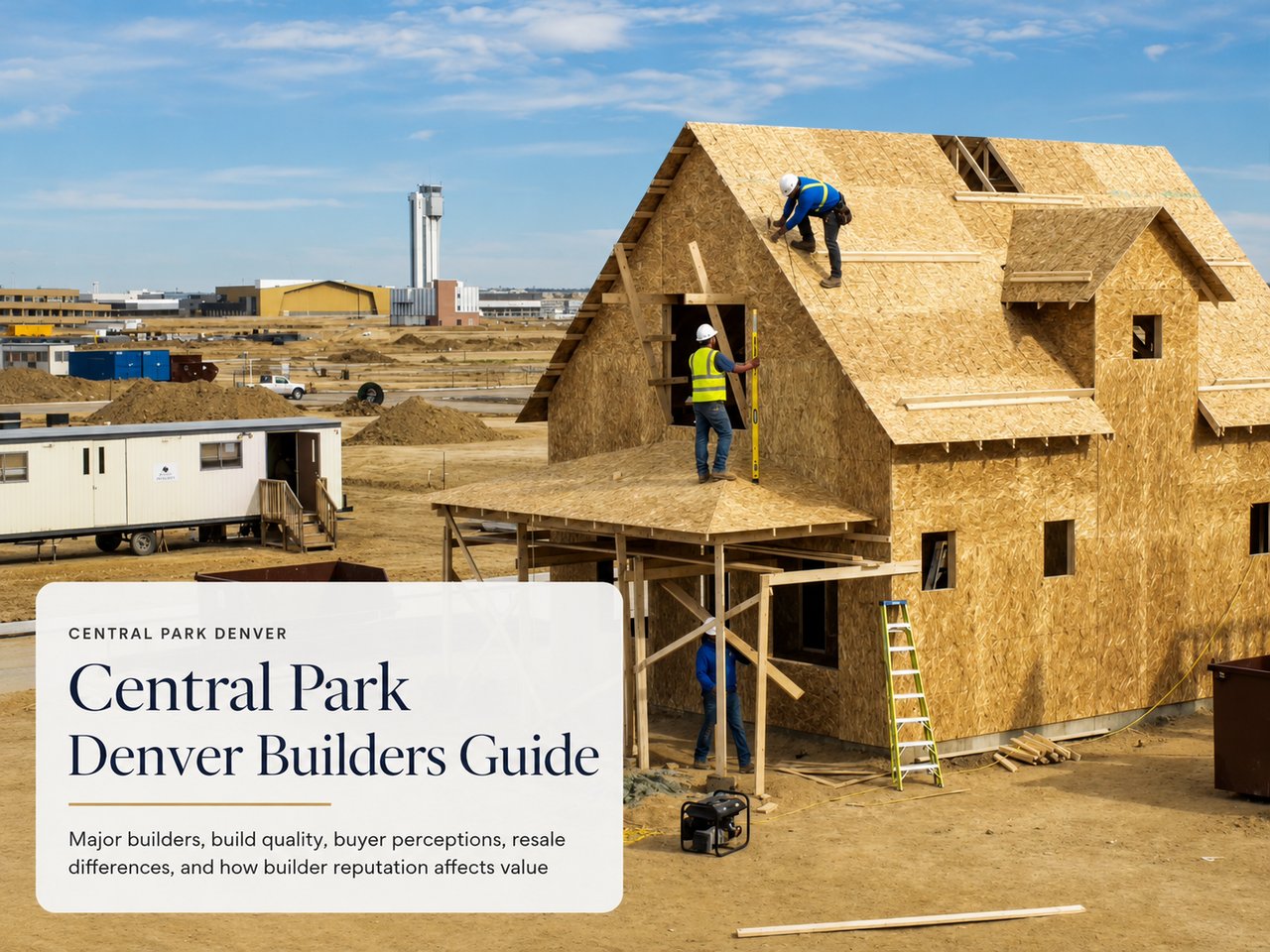
Central Park Denver Builders Guide
One question buyers ask early in their search is who actually built the homes in Central Park. Because the neighborhood grew in phases over roughly two decades, a wide range of Central Park Denver builders left their mark, each with different floor plans, design styles, and construction approaches. Understanding who built what, and how buyers tend to perceive those builders, can help you evaluate any individual home with a clearer eye.
This guide walks through the major builders that shaped Central Park, how building approaches differ, what tends to vary in quality and design, and how builder reputation can influence resale. The aim is to give you context, not a ranking, because the right home depends far more on the specific property than on the name on the original sales brochure.
Why builders matter in a master planned community
In a master planned community, the developer sets the overall framework, but individual builders construct the homes within it. That means two houses on the same street can come from different builders, different years, and different design philosophies, even while sharing the neighborhood's broader design standards.
For buyers, this matters because builder choice influences floor plans, finishes, energy systems, and the general feel of a home. For sellers, it can influence how buyers compare your home to others nearby. Knowing the builder is one useful data point among many, alongside condition, location, and comparable sales.
The major builders in Central Park
Over the life of the community, a number of well known builders constructed homes across its neighborhoods. Commonly seen names include:
- Infinity Home Collection
- Thrive Home Builders (formerly New Town Builders)
- Wonderland Homes
- David Weekley Homes
- Parkwood Homes
- KB Home
- Standard Pacific (later part of CalAtlantic and Lennar)
- McStain Neighborhoods
- Boulder Creek Neighborhoods
- Berkeley Homes
The community was guided over time by master developers Forest City and later Brookfield Residential, and income qualified homes were built in partnership with organizations such as Northeast Denver Housing. Because builders rotated through different filings and neighborhoods, the builder you encounter often depends on which part of Central Park and which construction era you are looking at.
Production, semi custom, and custom approaches
Builders in Central Park generally fall along a spectrum from production to semi custom to custom.
Production builders focus on a set menu of floor plans with defined options, which can offer efficiency and predictability. Semi custom builders allow more personalization within a framework. Custom and luxury focused builders, often on premium or larger lots, offer the most flexibility and typically the highest price points.
None of these approaches is inherently better. They serve different budgets and priorities. A buyer who values choice and personalization may gravitate toward semi custom or custom homes, while a buyer who values a streamlined process may prefer a production plan.
Build quality and what actually varies
Buyers often ask which builder has the best quality. The honest answer is that quality is best evaluated home by home rather than by brand alone. What tends to vary includes floor plan layout, finish levels, energy systems, lot position, and how well a particular home has been maintained since it was built.
A well kept home from one builder can show better than a neglected home from another, even if the second builder carried a stronger original reputation. This is why a professional inspection and a review of recent comparable sales matter more than any general assumption about a builder. If you are weighing the value of a specific home, our home value guide walks through the factors that actually drive price.
Energy efficiency and newer construction standards
One feature that comes up often in Central Park is energy efficiency. Some builders in the community, particularly Thrive Home Builders and its predecessor New Town Builders, became known for a focus on energy efficient and high performance construction.
For buyers, energy features can affect comfort and ongoing utility costs, and they sometimes appeal to a segment of buyers at resale. As with any feature, it is worth verifying what a specific home actually includes rather than assuming, since systems and standards changed across construction years.
How buyers perceive builders
Builder perception is real, and it can influence demand. Some buyers arrive with preferences shaped by a model home they once toured, a friend's experience, or a particular design style they associate with a builder. These perceptions can affect how quickly a home attracts interest.
At the same time, perception and reality do not always line up. A builder's reputation may be based on a specific product line or era that differs from the home in front of you. The most reliable approach is to evaluate the actual property, its condition, and its comparables, then treat builder reputation as supporting context rather than the deciding factor.
Builder reputation and resale value
Builder reputation can play a supporting role in resale. A builder associated with desirable floor plans or strong design can add to buyer interest, which may help a well positioned home. But reputation rarely overrides the fundamentals.
Pricing discipline, condition, micro location within the neighborhood, ownership costs, and current market conditions tend to carry more weight than the builder name. A home priced correctly and presented well usually performs better than a home that leans on builder reputation alone. Our guides to pricing and selling strategy and preparing a home for sale go deeper on what moves the needle.
How to evaluate a specific home, regardless of builder
Whatever the builder, the same fundamentals apply. Review the floor plan against how you actually live. Inspect the condition and major systems. Compare the home to recent sales of similar properties nearby. Understand the HOA and any metro district costs. Consider the lot, the micro location, and long term resale appeal.
If you are comparing attached and detached options across builders, our overview of condos and townhomes in Central Park is a helpful companion, and buyers focused on the higher end can review our luxury real estate overview.
Frequently asked questions
Who built the homes in Central Park Denver? Many builders contributed over roughly two decades, including Infinity Home Collection, Thrive Home Builders, Wonderland Homes, David Weekley Homes, Parkwood Homes, KB Home, Standard Pacific, McStain Neighborhoods, Boulder Creek Neighborhoods, and Berkeley Homes, guided by master developers Forest City and later Brookfield Residential.
Which Central Park builder has the best quality? Quality is best judged home by home rather than by brand. Floor plan, finishes, lot position, and maintenance vary widely, so an inspection and a review of comparable sales tell you more than a builder name alone.
Does the builder affect resale value? It can play a supporting role, since some builders carry a stronger buyer perception, but pricing, condition, location, and market conditions usually matter more.
Are Central Park homes energy efficient? Some builders focused on energy-efficient construction, with Thrive Home Builders and its predecessor, New Town Builders, often noted for it. Always verify the specific systems and features in any individual home.
Comparing homes from different builders?
The builder is one piece of the puzzle. The full picture comes from the specific home, its condition, its comparables, and how it fits your budget and plans. If you would like a neutral, side-by-side read on homes from different Central Park builders, reach out to The Neir Team and we will help you compare.
Contact The Neir Team or call (720) 935-4399 to talk it through.
By Alex Neir, Denver Real Estate Broker
Specializing in Central Park & luxury residential sales